Baby Kangaroo 2.0 Tactile First Look: Unboxing and Impressions
The mechanical keyboard community is often characterized by a relentless pursuit of the perfect tactile event—that elusive moment where the collapse of a spring and the engagement of a leaf create a physical response that feels both intentional and satisfying. Gateron, a mainstay in the enthusiast market, has spent years refining its catalog to cater to these specific sensory demands. One of their most celebrated recent releases was the original Baby Kangaroo switch, which combined a snappy tactile bump with a unique acoustic profile. Now, the iteration cycle has brought us the Baby Kangaroo 2.0 Tactile. This update seeks to address minor consistency issues in the first generation while doubling down on the qualities that made the original a favorite for typists and coders alike.
In the world of electronics and computer peripherals, the switch is the fundamental interface between the user’s intent and the machine's execution. For professionals who spend eight to twelve hours a day at a desk, the difference between a mushy, generic switch and a high-performance tactile switch like the Baby Kangaroo 2.0 is not merely aesthetic; it is a matter of ergonomic comfort and typing accuracy. This first look explores the nuances of the 2.0 version, from the initial unboxing experience to the deep technical changes that affect how these switches feel under the fingers during a heavy workload.
The Unboxing Experience and Initial Build Quality
Upon receiving a batch of Baby Kangaroo 2.0 switches, the first thing one notices is the attention to structural integrity. These are not budget-grade components. The switches arrive in organized trays that prevent pin bending during transit—a common frustration with bulk-shipped clones. Taking a single switch out of the housing, the weight and tightness of the tolerances are immediately apparent. There is virtually no north-south or east-west wobble in the stem, which is a testament to the improved mold designs Gateron is utilizing for this "2.0" series.
The visual design remains iconic, featuring a translucent green housing and a high-contrast yellow stem. However, the materials have seen an upgrade. The top housing is constructed from a high-grade polycarbonate that allows for excellent light diffusion for those utilizing RGB-heavy PCBs, while the bottom housing uses a nylon blend designed to deepen the sound signature. The stem itself is made of POM (Polyoxymethylene), a self-lubricating plastic that ensures the switch becomes smoother over time rather than wearing down and becoming scratchy.
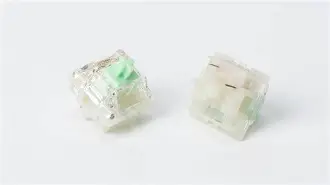
Inside the switch lies the heart of the "Kangaroo" experience: a 22mm extra-long dual-stage spring. This specific spring configuration is what gives the switch its "snappy" return. Unlike standard springs that provide a linear increase in resistance, the dual-stage spring in the Baby Kangaroo 2.0 provides a high initial force, making the tactile bump feel more pronounced and preventing the "lazy" return that plagues many other tactile switches. This creates a rhythmic typing experience that feels energetic and responsive.
Technical Analysis: The Tactile Event
To understand why the Baby Kangaroo 2.0 is a significant release in the electronics space, one must analyze the force curve. Most tactile switches fall into two categories: the "clothespin" style, where there is a sharp drop after a high peak, and the "rounded" style, where the tactility feels like a smooth hill. The Baby Kangaroo 2.0 occupies a middle ground that enthusiasts often call "P-shaped" tactility. The bump begins almost immediately at the start of the keypress, with very little pre-travel. This means the moment you rest your finger on the key and apply pressure, you are met with resistance that breaks cleanly.
The 2.0 revision specifically focuses on "factory lubing." In previous generations, factory lubrication could be inconsistent, with some switches feeling over-greased and others feeling bone dry. Gateron has implemented a new automated precision-lubing process for the 2.0. The lubricant is applied sparingly but effectively to the rails, the stem legs, and the leaf contact points. This results in a switch that is "keyboard ready" right out of the box, saving enthusiasts hours of manual labor. For the average buyer who wants a premium experience without the hobbyist overhead of opening 100 individual switches, this is a major selling point.
Acoustically, the Baby Kangaroo 2.0 is designed to be "poppy." Because of the long pole stem—meaning the center pole of the stem hits the bottom of the housing before the outer edges do—the sound is concentrated and high-pitched. It avoids the "thuddy" or muted sound of silent switches, providing a clear auditory confirmation of every keystroke. In an office environment, this sound is distinctive but not as piercing as a "clicky" blue switch, making it a sophisticated choice for professional settings.
Real-World Use Cases: Typists vs. Gamers
When evaluating electronics, context is everything. A switch that is perfect for a novelist might be a nightmare for a competitive gamer. The Baby Kangaroo 2.0 is unapologetically aimed at the typist. The high tactile force (around 59g at the peak) and the immediate bump provide a level of feedback that reduces typos. When you feel that bump, you know the character has been registered. This makes it an exceptional choice for software developers, writers, and data entry professionals who rely on muscle memory and high-speed input.
Looking for the best Electronics deals on Amazon?
See Deals →For gaming, the verdict is more nuanced. In tactical shooters or strategy games where deliberate, single-press actions are common, the Baby Kangaroo 2.0 performs admirably. The fast return of the dual-stage spring allows for quick successive taps. However, for "spam-heavy" genres like rhythm games or certain MMOs, the heavy tactility might lead to finger fatigue over long sessions. Gamers who prefer a "hair-trigger" feel will likely find these too resistive, but those who enjoy "feeling" their actions will appreciate the deliberate nature of the 2.0.
Another often-overlooked factor is the compatibility with different keycap profiles. Because the Baby Kangaroo 2.0 has such a strong return and stable stem, it handles heavy, thick PBT keycaps in the MT3 or SA profile exceptionally well. These taller keycaps often make weaker switches feel sluggish, but the Kangaroo’s dual-stage spring counteracts the added weight of the plastic, maintaining a crisp feel regardless of the furniture sitting on top of it.
Comparison and Specifications
To better understand where the Baby Kangaroo 2.0 sits in the current market, it is helpful to compare it to its predecessor and its primary competitors, such as the Holy Panda and the Boba U4T. While the Holy Panda is often cited as the gold standard for tactility, it often requires manual maintenance to reach its full potential. The Boba U4T is known for its "thocky" or deep sound. The Baby Kangaroo 2.0 distinguishes itself by prioritizing "snap" and out-of-the-box consistency.
| Feature | Baby Kangaroo 1.0 | Baby Kangaroo 2.0 | Industry Standard (Mid-Tactile) |
|---|---|---|---|
| Tactile Peak Force | ~59g | ~59g (Increased Consistency) | 45g - 55g |
| Spring Type | 22mm Dual-Stage | 22mm Gold-Plated Dual-Stage | 15mm Single-Stage |
| Housing Material | PC/Nylon | Reinforced PC/Nylon Blend | Varies (Usually All PC) |
| Factory Lube | Standard Application | Precision Automated Lube | Dry or Minimal |
| Stem Wobble | Moderate | Low (Revised Molds) | High |
| Expected Lifespan | 50 Million Keystrokes | 80 Million Keystrokes | 50 Million Keystrokes |
Pros and Cons
No piece of hardware is perfect, and the Baby Kangaroo 2.0 is a specialized tool that fills a specific niche. Here is a breakdown of what makes it shine and where it might fall short for certain users.
- Pro: Immediate Tactility – The lack of pre-travel creates a very "high-definition" typing experience where the feedback is instant.
- Pro: Outstanding Factory Lube – This is arguably the best "stock" experience Gateron has ever offered, making it accessible for beginners.
- Pro: Visual Appeal – The bright green and yellow aesthetic is unique, and the transparent top housing works wonders for RGB enthusiasts.
- Pro: Structural Stability – The 5-pin design and tight tolerances ensure the switch feels solid even on plateless builds.
- Con: Acoustic Profile – The "poppy" long-pole sound can be polarizing. Those who want a quiet, deep sound may find it too loud.
- Con: Fatigue Potential – The dual-stage spring is aggressive. Users transitioning from light linear switches may need a week to adjust to the higher resistance.
- Con: Specificity – It is very much a typist's switch; it lacks the versatility of a more balanced "brown-style" tactile switch.
Buying Guide: Is the Baby Kangaroo 2.0 Right for You?
When considering an upgrade to your peripheral setup, it is important to match the component to your existing hardware and your personal habits. The Baby Kangaroo 2.0 is a 5-pin (PCB mount) switch. While the two extra plastic pins can be clipped off with flush cutters to fit 3-pin (plate mount) keyboards, it is ideally suited for modern hotswap PCBs that support the 5-pin standard. The stability offered by the extra pins is worth the effort if your board supports it.
Potential buyers should also consider their keyboard's mounting style. In a "gasket mount" keyboard, which is designed to be flexy and soft, the Baby Kangaroo 2.0 provides a sharp contrast that can make the board feel more substantial. In a "tray mount" or stiff "integrated plate" keyboard, the aggressive tactile bump and long pole bottom-out might feel a bit harsh on the joints. If you prefer a "stiff" typing experience, these will be perfect. If you prefer a "bouncy" or soft feel, you might want to pair these with a softer plate material like FR4 or POM rather than brass or aluminum.
Furthermore, consider your sound environment. If you work in a quiet open-plan office, the Baby Kangaroo 2.0 might draw attention. While not as obnoxious as a clicky switch, the "clack" of the long pole is audible. For home offices or private spaces, however, the sound is often described by enthusiasts as "musical" and "rhythmic," providing a satisfying cadence to a long day of typing.
Refining the Professional Workspace
The shift toward high-end mechanical switches in the professional world reflects a broader trend in electronics: the move away from disposable, "good enough" equipment toward tools that can be maintained and customized. The Baby Kangaroo 2.0 is part of this ecosystem. Because the materials used—specifically the POM stem and gold-plated springs—are designed for longevity, these switches can easily outlast the computer they are plugged into. They represent a one-time investment in the quality of one's digital interactions.
Discover deals on Electronics — updated daily.
See Deals →Buyers often care about "consistency," which is where the 2.0 truly excels. When you buy a set of 100 switches, you expect switch number 1 to feel exactly like switch number 100. In the past, manufacturing variances meant that a "tactile" switch might feel "linear" if the leaf wasn't bent correctly. Gateron's 2.0 manufacturing process has tightened these tolerances significantly. This level of reliability is what separates an enthusiast component from a mass-market commodity.
From an electronics engineering perspective, the 2.0 update also features improved contact points. The gold-plated contacts are more resistant to corrosion and oxidation, ensuring that the electric signal remains clean over years of use. This prevents "chatter" or "double-typing," a common failure mode in older or cheaper mechanical switches. For someone relying on their keyboard for mission-critical work, this electrical reliability is just as important as the physical feel.
Natural Evolution of the Gateron Line
Looking at the broader catalog, the Baby Kangaroo 2.0 bridges the gap between the budget-friendly Gateron Cap switches and the ultra-premium Gateron Ink series. It takes the lessons learned from the "Oil King" (a linear switch) regarding lubrication and applies them to a tactile housing. This cross-pollination of technologies within Gateron's factory has resulted in a product that feels more mature than the 1.0 version. It doesn't try to reinvent the wheel; it simply polishes every surface of the wheel to a mirror finish.
The "tactile feel" is notoriously subjective. Some want a switch that feels like breaking a thin glass rod, while others want a switch that feels like pushing through a thick gel. The Baby Kangaroo 2.0 leans toward the "glass rod" end of the spectrum. It is sharp, fast, and uncompromising. If you have found yourself bored with traditional tactile switches that feel like "linears with a bit of sand in them," the 2.0 will be a revelation. It is a switch that demands to be felt, turning every email and every line of code into a tactile event.
Conclusion
The Baby Kangaroo 2.0 Tactile is a masterclass in iterative improvement. By focusing on the details that enthusiasts usually fix themselves—consistency, lubrication, and housing wobble—Gateron has created a switch that is as close to perfect as a mass-produced component can get. It honors the legacy of its predecessor by keeping the snappy, energetic feel of the dual-stage spring while upgrading the materials and manufacturing processes to meet modern standards of excellence.
For the professional user, the 2.0 offers an immediate improvement in typing feedback and accuracy. For the hobbyist, it provides a high-quality base that requires zero modifications to enjoy. While the aggressive bump and distinct sound might not be for everyone, those who prioritize a responsive, high-feedback interface will find the Baby Kangaroo 2.0 to be one of the most rewarding upgrades they can make to their workstation. In the vast landscape of keyboard electronics, it stands out as a thoughtful, well-engineered solution for the modern digital craftsperson. Whether you are building your first custom board or looking to refresh a long-time favorite, these switches provide a tactile experience that is truly second to none.